The Brief
A Drop-In System in a Live Festival Environment
T Lounge at Okeechobee isn't a permanent venue — it's a temporary environment assembled inside a festival, surrounded by multiple active stages competing for acoustic real estate. The engineering challenge wasn't just about delivering great sound inside the tent. It was about doing that while keeping energy from leaking out and polluting adjacent performances.
The system had to be fully self-contained and deployable as a complete drop-in package: no permanent infrastructure, no acoustic treatment, no dedicated power plant. Everything had to arrive on trucks, assemble cleanly within the footprint of the space, perform at audiophile standards, and not bleed significantly beyond its walls.
For a 1,500-person dance environment surrounded by other active stages, that's a non-trivial problem. It demands precision in both subwoofer array configuration and high-frequency coverage control — and it demands that both be tuned to work together, not just individually.
The Engineering Problem
Controlling Low-Frequency Energy in a Multi-Stage Environment
Low frequencies are omnidirectional by nature. A single subwoofer radiates in all directions equally — which means every decibel of bass energy created inside T Lounge is also trying to escape through every wall into adjacent stages. At festival scale, that's not just an acoustic problem; it's a production conflict with the teams on either side of you.
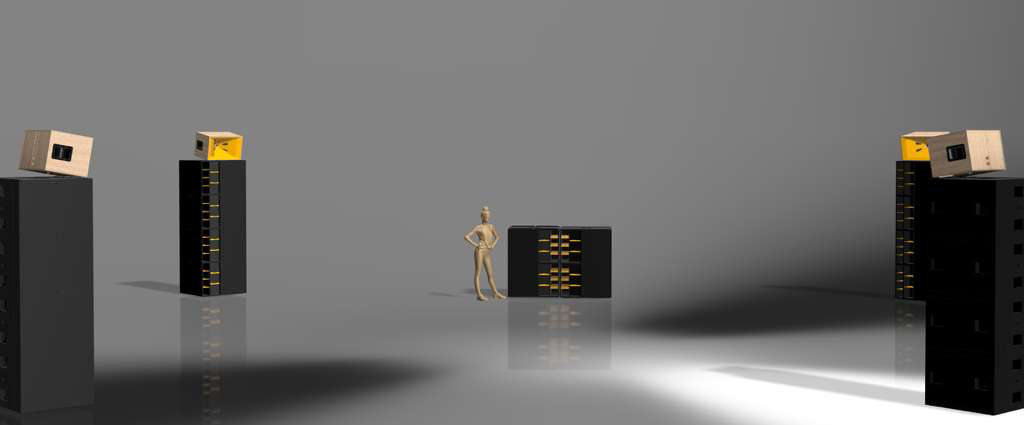
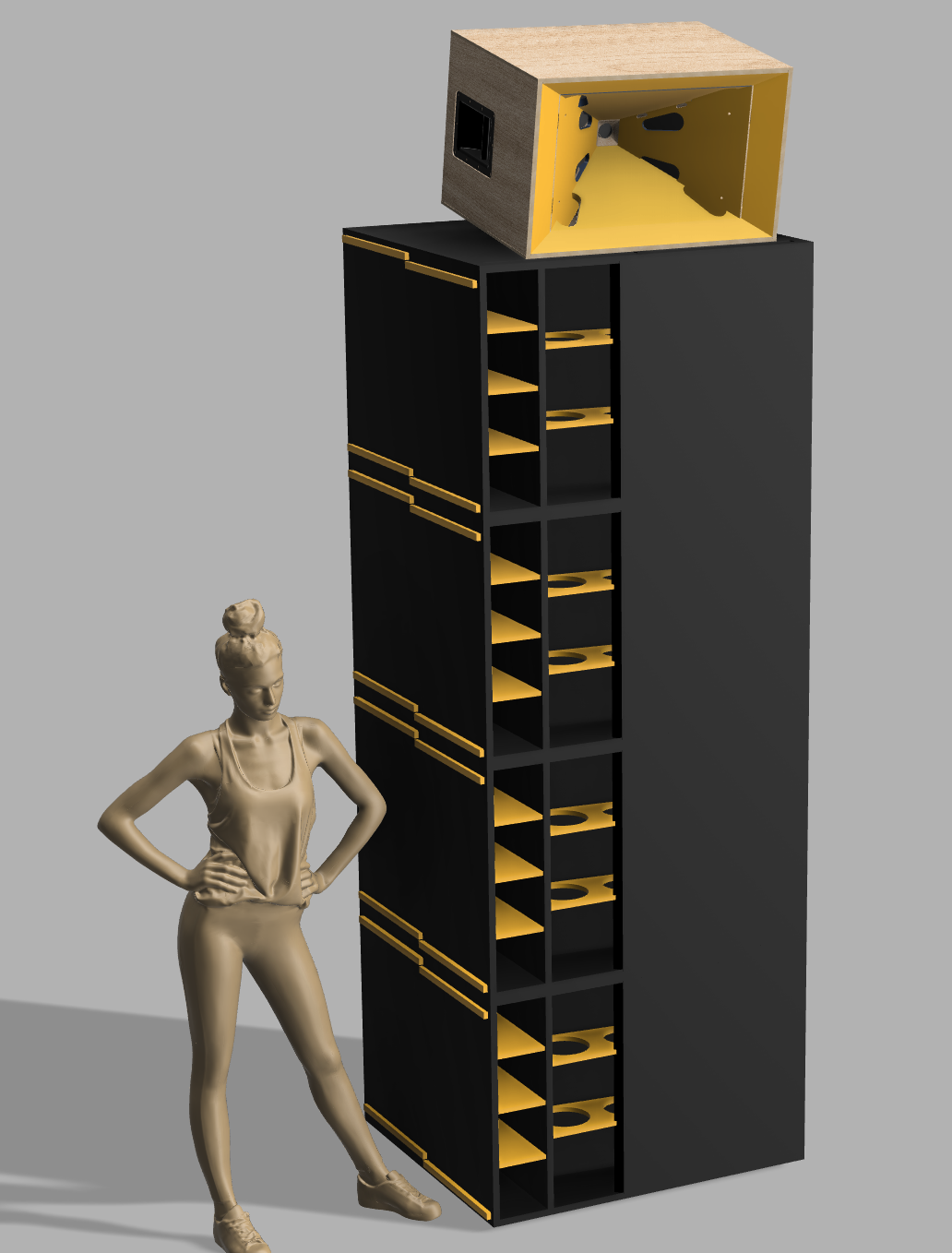
The solution at T Lounge was a four-point distributed tower system with real-time dynamic delay and magnitude control at each tower. Rather than deploying a conventional array from a single position, four independent towers — each carrying four 21″ SKRAM subwoofers with JMOD horns on top — were distributed across the stage plot. A dedicated infrasonic center cluster with a center-fill horn completed the low-end coverage.
The critical capability this enabled: each tower can be independently delayed or its output magnitude adjusted in real time during the show. By manipulating the phase and level relationships between towers, cancellation zones can be actively steered away from adjacent stages while constructive summation is directed toward where people are actually congregating on the dance floor. This isn't a fixed pattern — it's a dynamic system that responds to the live environment.
Cardioid Principles, Applied Dynamically
The T Lounge system used cardioid bass principles — exploiting delay and phase relationships between towers to create destructive interference in targeted directions. What made this approach different was that those relationships weren't fixed at setup. Delay and magnitude at each tower could be adjusted in real time during the show, allowing the cancellation pattern to be steered as conditions changed — without stopping the music.
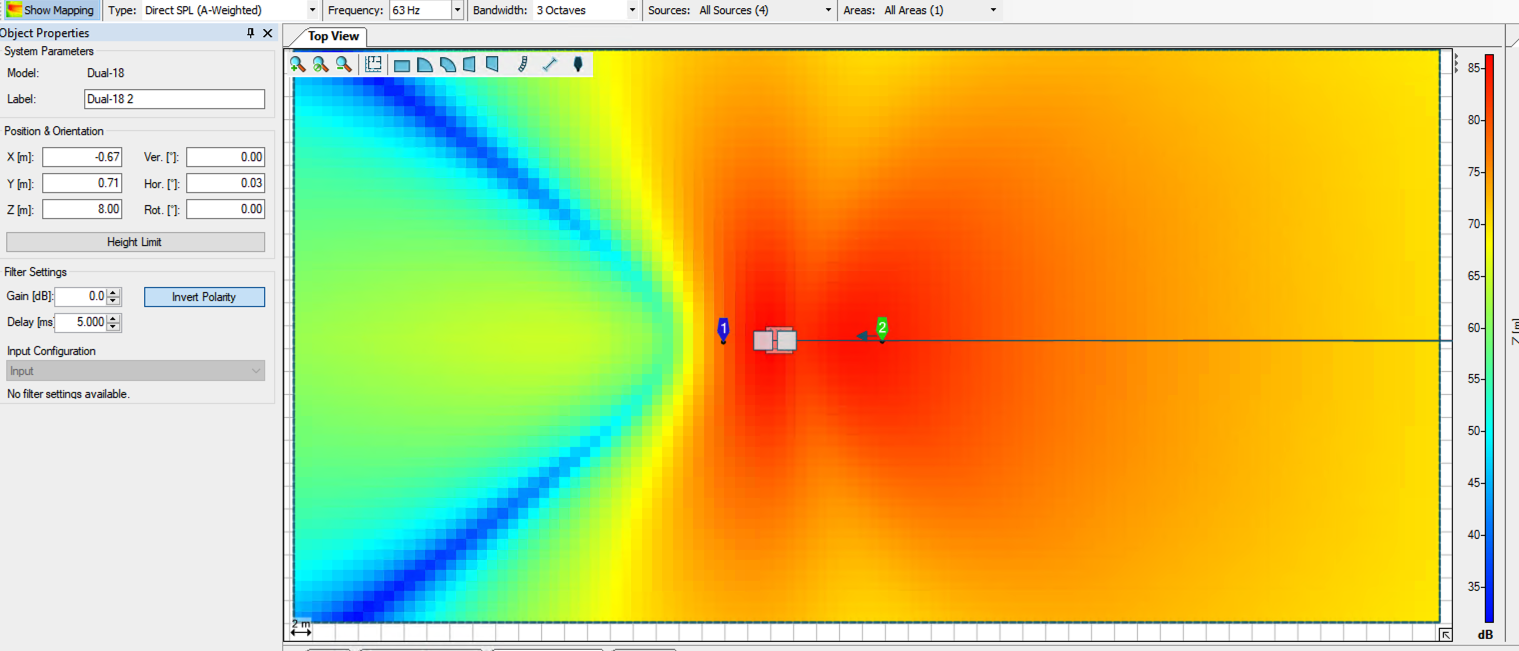
Acoustic prediction model — top-down SPL heat map used in the design phase to model the energy steering behavior. Red indicates zones of high SPL concentration; blue indicates the rear cancellation zone. The actual deployment allowed this pattern to be adjusted dynamically during the event.
The result: maximum immersion on the dance floor, minimal interference outside it — with the ability to tune that balance in real time as the show evolved.
System Scale
3.5 Square Meters of Moving Air
The T Lounge system moves more than 3.5 square meters of speaker cone area — a physical quantity of air displacement that creates the chest-hitting, body-felt bass that defines great dance music systems. This isn't achieved by turning up gain; it's achieved by deploying enough driver area that the system can operate at moderate excursion levels across the entire operating range, including infrasonic content below 15Hz that most systems can't reproduce at all.
Custom multi-exit horns and coaxial compression drivers handle the high-frequency side — providing the precise, direct stereo imaging that allows the system to create a genuine stereo field rather than just a loud mono wash. Four-point imaging means every position on the dance floor has a consistent sense of placement and width.
Measurement & Tuning
Tuned with Dual-Channel FFT — Then Sanity-Checked with Subjective Listening
Before the system was ever loaded into the festival site, the coverage pattern and crossover behavior were modeled in acoustic prediction software. The layout of the stacks, the angle of the arrays, and the delay relationships between drivers were all resolved in simulation — so that by the time equipment hit the floor, the setup was a confirmation process rather than a guessing process.
On-site, dual-channel FFT analysis was used to align the system to the Michael Lawrence target trace across multiple measurement positions throughout the listening area. Phase alignment was verified at every crossover point, and the low-frequency steering pattern was confirmed by walking the perimeter of the tent with a calibrated measurement mic.
Once the measurements were locked in, the system was sanity-checked through extended subjective listening sessions — using familiar music from both our engineers and our stage partners. Many hours of refinement across voicing, spatial balance, and low-end character followed. The numbers tell you when something is right. The music tells you when it's right.
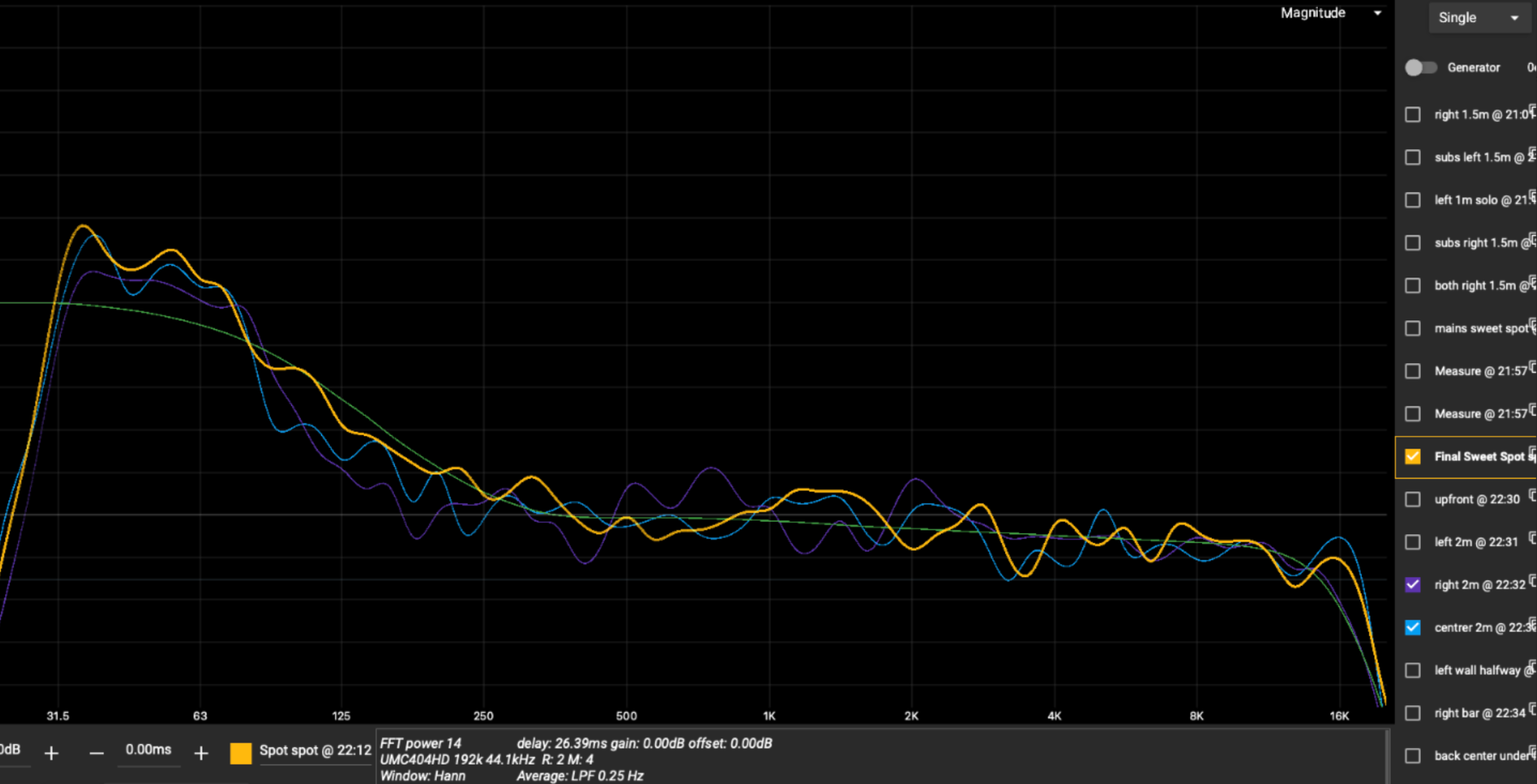
Dual-channel FFT measurement across multiple listening positions in T Lounge. Consistency of response across positions reflects the accuracy of the prediction modeling and the effectiveness of the four-tower dynamic steering approach.
"Even with all of the science involved, at the end of the day the system just feels right. When everything is aligned correctly, the music becomes the environment around you."
Julian Lee — A1 & Lead Systems Engineer, Sound Decisions
Philosophy
A Festival Stage Treated Like a Listening Room
The T Lounge approach borrows from high-end audiophile design principles — the idea that a system should be tuned to disappear, so that what you experience is entirely the music, not the system reproducing it. Precision horn loading, phase-aligned crossovers, and measurement-based EQ decisions are the tools; an immersive, coherent listening experience across every position in the room is the goal.
What makes this unusual in a festival context is that most festival systems are tuned primarily for maximum output at the mix position. T Lounge was tuned for consistency across the entire floor — which is a fundamentally different and more demanding standard.
"A great sound system should disappear. When the tuning is right, all you notice is the music."
Jeremy Ishmel — A2 & System Tech, Sound Decisions
Open Architecture
Built on Open-Source Design, Shared Openly
The SKRAM subwoofer cabinet and JMOD horn designs are both open-source DIY designs — meaning the cabinet geometry, driver specifications, and crossover targets are publicly available for anyone to build. Sound Decisions built these cabinets from scratch, loaded them with professional-grade drivers, and tuned them to touring standards.
This approach is central to the Sound Decisions philosophy: exceptional outcomes come from engineering discipline and curiosity, not from brand prestige or proprietary black boxes. The fact that this system competes with — and outperforms — commercial touring systems costing multiples more is a direct demonstration of that principle.
We share our measurement techniques, tuning approaches, and system design thinking openly, because the goal isn't to protect a proprietary advantage. It's to raise the standard for what live sound can be.
System Specification
T Lounge Full Spec
Mid/High Tops
6× JMOD Multi-Exit Horn loudspeakers — coaxial compression drivers and dual 12″ mid drivers (B&C)
Dance Stack Subs
16 × 21″ SKRAM subwoofers across four independent towers — Eighteen Sound drivers, dynamically delay-steered for rejection control
Infrasonic Array
4× 21″ SKRAM center-cluster — Eminence drivers, forward-aligned, reaching below 15Hz
Amplification
Touring racks delivering 100kW+ available system power
DSP
FIR-capable DSP with precision crossover alignment and per-tower dynamic delay and magnitude control for real-time energy steering
Measurement
Dual-channel FFT — tuned to ±3dB of Michael Lawrence target, phase-aligned at all crossover points across multiple positions
Imaging
Four-tower distributed imaging — consistent stereo field and LF coverage across entire 1,500-person dance floor, steerable in real time
Deployment Type
Full drop-in package — no permanent infrastructure, self-contained power and signal distribution
Deployment
In the Field
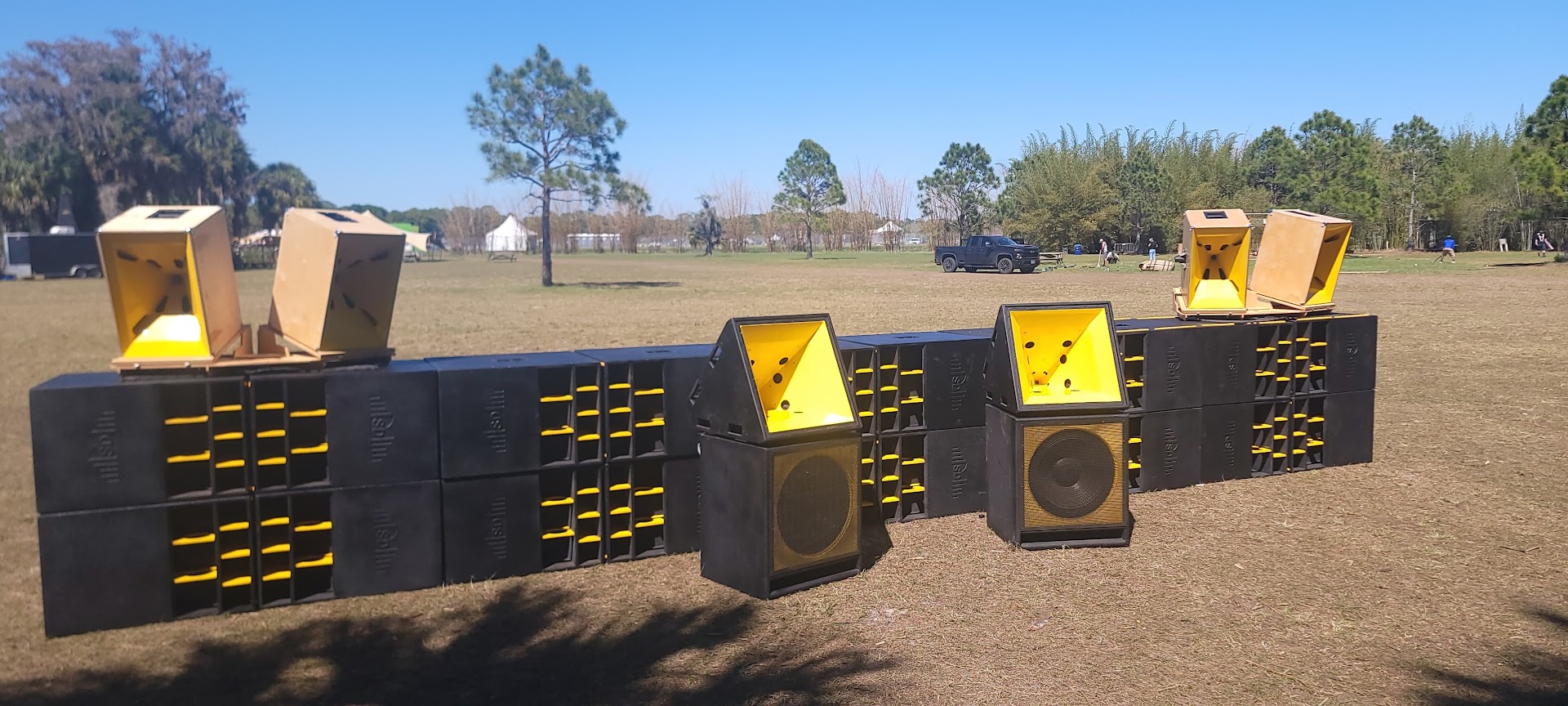
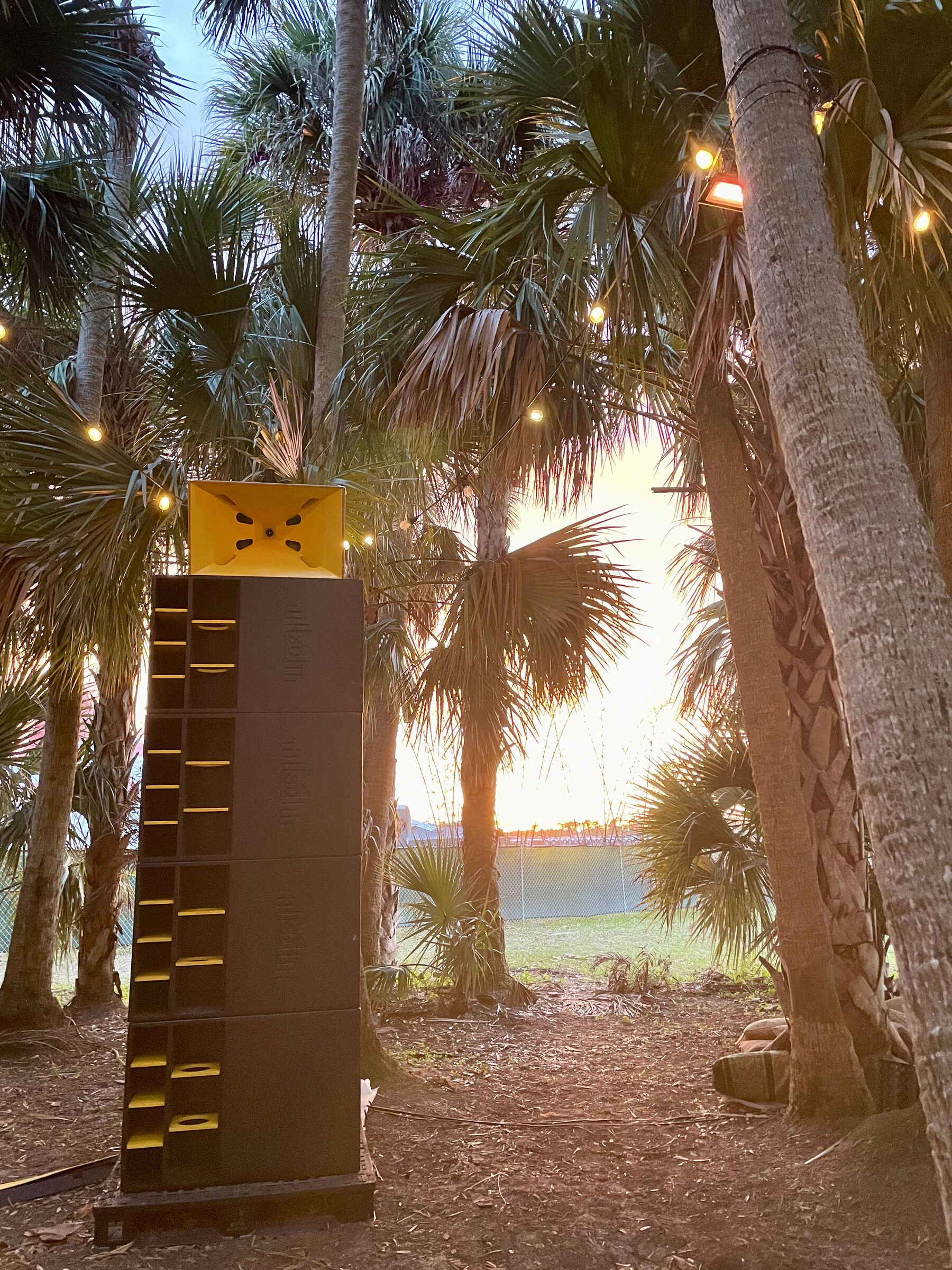
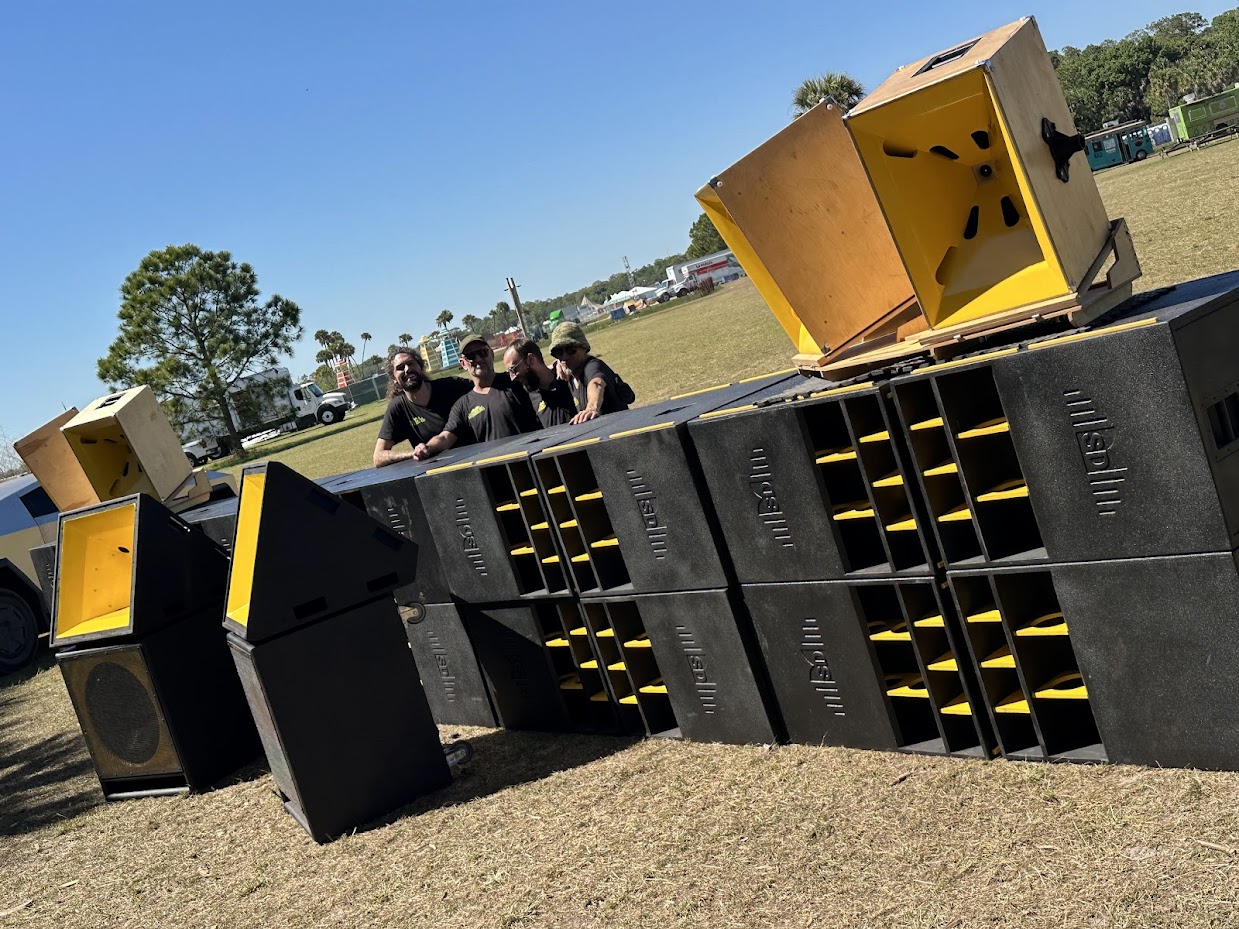
The full four-tower system staged at Okeechobee. Each tower carries four 21″ SKRAM subwoofers with a JMOD multi-exit horn on top — deployed as four independent points that can be individually delayed and steered in real time.
Loadout at Okeechobee. Palm trees, festival grounds, four towers worth of sub cabinets.
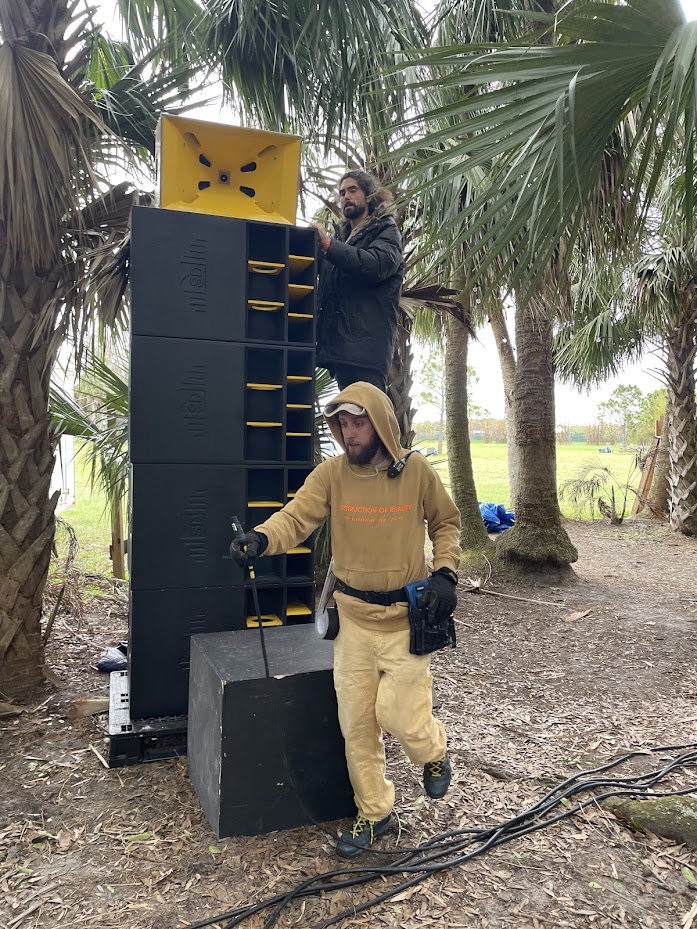
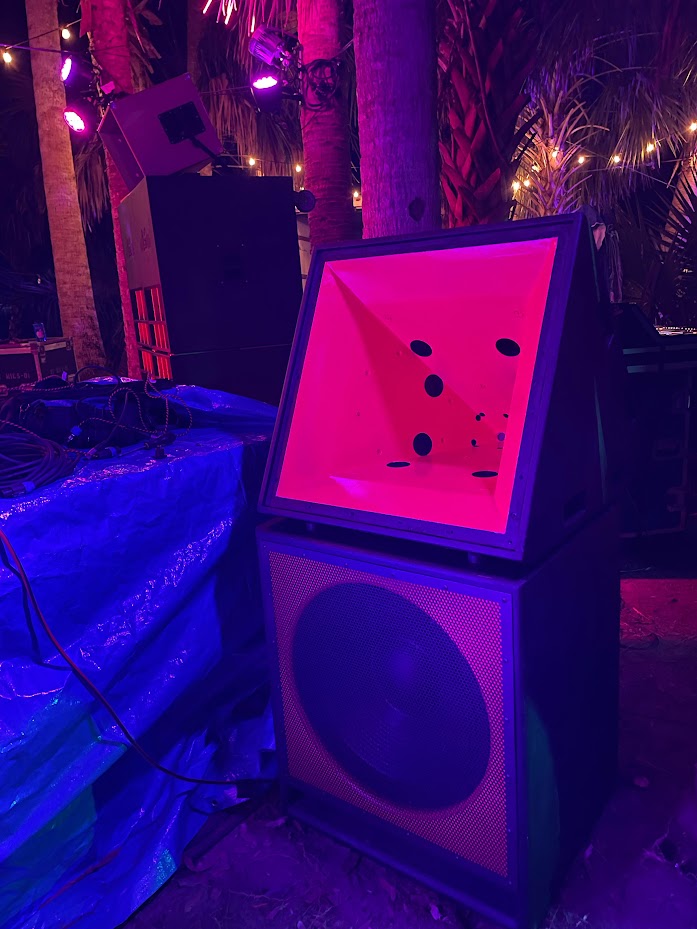
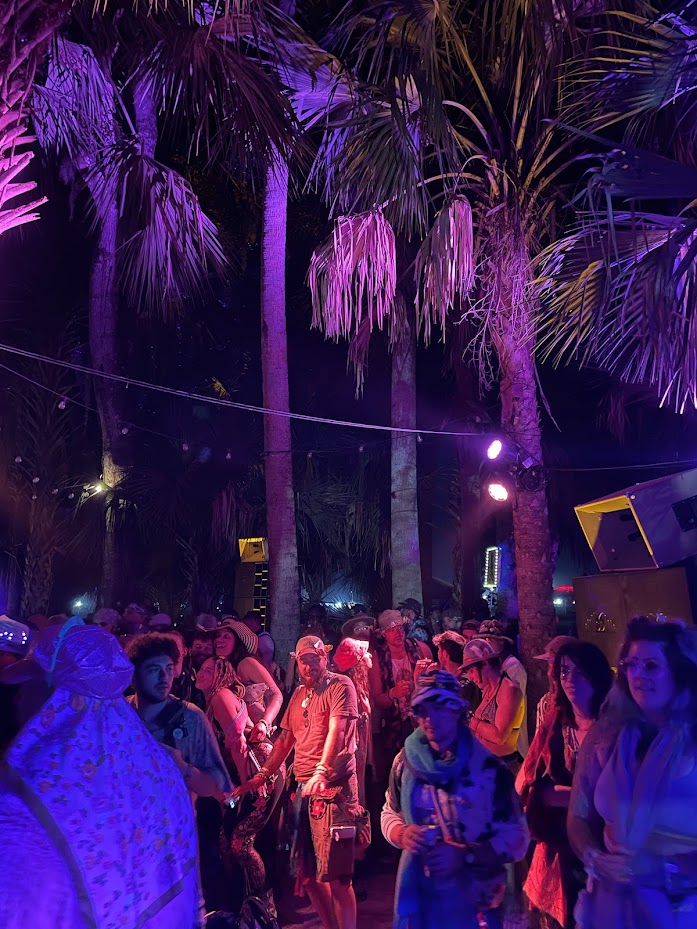
Left: JMOD horn at the event. Right: The crowd that showed up — 1,500 people between the palm trees.
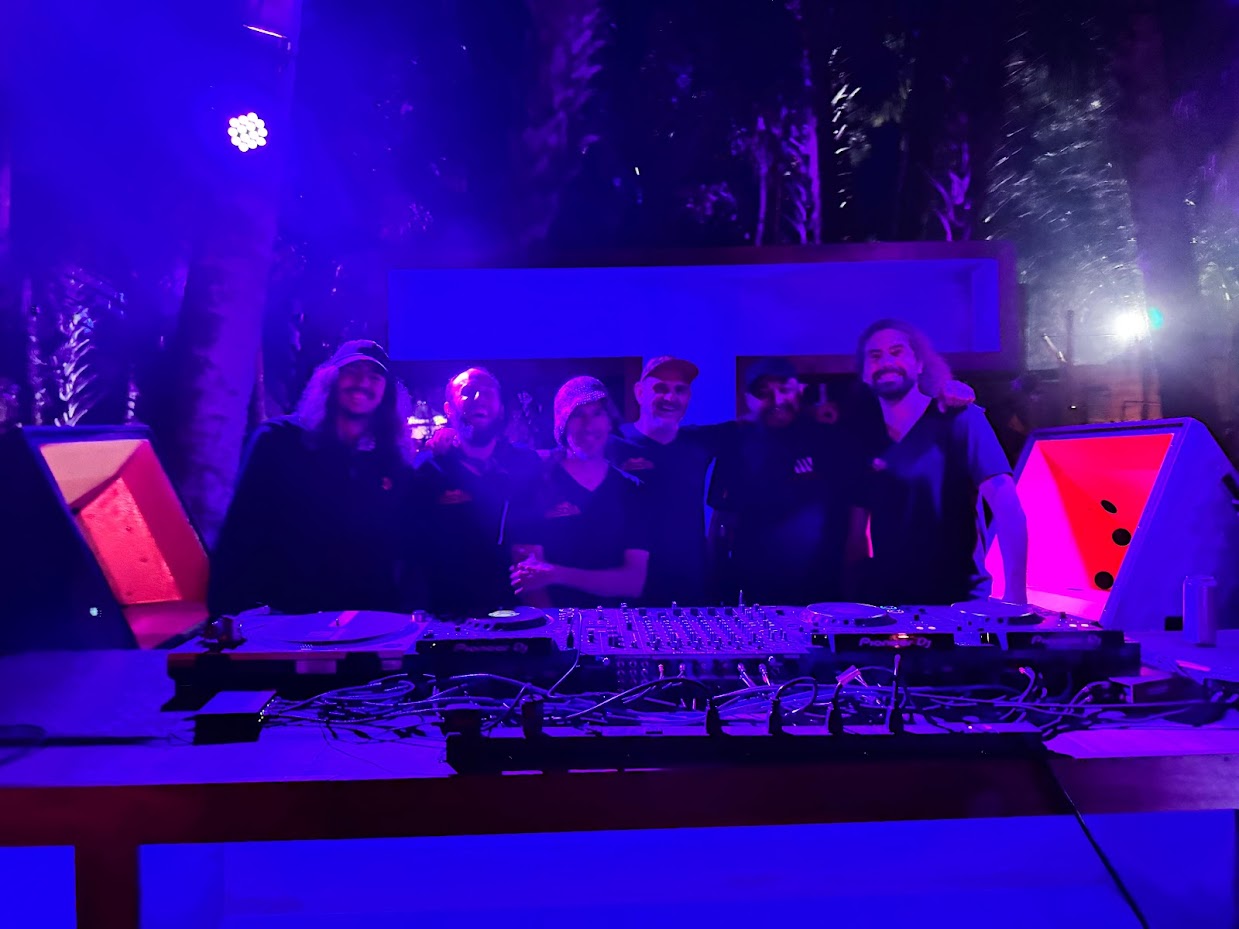
The team at the mix position. Real-time dynamic delay and magnitude control — steering cancellations, chasing the crowd.
The Team
Who Built It
Jason Phillips
Principal Systems Engineer · Founder
Julian Lee
A1 · Lead Systems Engineer
Jeremy Ishmel
A2 · System Tech
Brent Hawkins
Systems Engineer · Builder · Painter
Bring This to Your Event
Looking for a drop-in system that delivers immersive, precise sound while staying in its lane acoustically? Let's talk.
Get in Touch